Sunday, November 29, 2020

A Noob's Opus XII Review and Bingo Raffle!

Hey there everybody and welcome to Lv.1 Onion Knight: The Final Fantasy Trading Card Game blog that’s needlessly confrontational about the bad takes people had about new cards in their dumb set reviews.

To say that we live in chaotic times would be a huge understatement. There’s a lot going on in the world that I can’t control, and a lot of the things that I used to be able to do regularly are no longer on the table. Time seems to have melded together into one huge amorphous blob. The most exciting my days get is donning my finest robes and bleakly looking out my apartment window, muttering Much that once was is lost, for none now live who remember it…” like I’m Galadriel from Lord of the Rings.

To be fair, I didn't need a pandemic to do that though. 

But despite the fact that the world can be one hell of a dismal place recently, there’s one thing that makes everything better. The one shining bright light that pierces through the darkness: Opening packs of new cards.

Does that sound incredibly hyperbolic? Absolutely. Am I sorely in need of the endorphin boost you get when you dive into a fresh batch of packs after waiting nearly eight months since Opus XI? Hell yes. But in all seriousness, there really is something incredibly cathartic about getting to dig into a whole new set after such a long break between releases. Locals may not be back in action for me (though I did somehow manage to stumble ass-backwards into a second-place win at my first tournament in eons using a Ninja deck of all things), but I can’t deny that coming up with new deck builds is definitely a welcome distraction from the looming specter of depression threatening to pummel me into oblivion on a daily basis.

And hoo boy, if there was any set that seems tailor made for some insane deck builds, it’s Opus XII. I feel like I say some variant of “Wao, these new cards are like, sooooo good you guys.”, or something every time I write one of these reviews, but the introduction of the new dual-element mechanic feels way more impactful on the game as a whole than stuff like the Damage keyword, counters, or whatever the monster-of-the-week effect is. Also a few of these cards may be a little too insane.

"Maybe this should be a once-per-turn effect?" "Nah, what are people going to suddenly run Ghido to take advantage of this or something?" 

If Opus XI was the “power creep set” (or perhaps more accurately the “Marche-Ritz-BFA” set), then Opus XII is the set that tenderly tucks your prior notions of just how powerful cards could get before promptly slapping them in the face with every card of your old decks.

The dual-element cards are the logical next step to those old Standard Unit cards from Opus VII that required their cost be paid with a specific element in order to get their effects off, but these are way better in every conceivable way. The versatility of being able to pitch the cards for any element combined with their overall sheer strength pretty much makes them staples for decks that run those elements - sometimes even in decks that only run one if you can find a way of generating CP of the other required element, or a way of getting them onto the field for free which is actually surprisingly easy.

Either way, the power level that was formerly reserved for Light or Dark cards seems to now be available to these new multi-element cards, which gives certain combinations a sizable leg up. Ranperre Lightning/Earth decks took a slight dip in popularity last set only to rocket right back on top again thanks to Regis’s absurd recovery effect allowing you to recycle self-breaking cards like Nyx and the new Gilgamesh for virtually no cost. Water/Lightning featuring the Scions of the Seventh Dawn took an early tournament win in Japan, with Thancred’s ability to cheat out the new Y’shtola or Lenna from the Break Zone giving an element combination that never really saw too much play in past sets some serious legs. Personally I’m excited to see just what kind of shenanigans can be pulled off with the new Faris, which is making me want to seriously revamp my old Warriors of Light deck from the ground up.

AKA the "How many Light cards are too many?" deck

Speaking of which, another thing I love about this set is that it continues with the trend of giving much-needed support to tribal decks. Samurai in Opus XI became one of my favorite decks, but it was one that would either result in a spectacular wipe of your opponent’s Forwards or a hard brick if you couldn’t get your combo pieces in hand, but now it appears to be shaping up into a top tier threat. I think that a lot of people evaluating the new cards tend to underestimate just how valuable something like a new 2 CP Backup with the correct job/name can be in amping up decks dependent on them. I personally was guilty of dismissing the new Dragoon backup as insignificant until I played against a new build and saw just how much quicker they can set up a massive board thanks to it. Either way, it’s really nice to see more “Edge-like” support cards for tribal decks in this set  – especially for Knights who haven’t had any real direct support since like… Opus VI? I guess I can finally live the dream of making that Fire Garland Legend work.

When I finally fulfill the ancient pact of a successful Fire/Water knight deck, I can finally depart this mortal coil at peace.

One other big thing about this set that can’t be overlooked is that it finally fixes what was, in my opinion, one of the worst mechanics in the game: Party attacks. Party attacks always kind of felt like a bit of flavor tacked on from the games that were never really “worth” the investment for any card not named Yuri/Chelinka. They were always more of an absolute last resort that could backfire on you since they would usually leave your side of the field more vulnerable.

But in Opus XII there’s so much new support for party attacks, and it’s all really good support too. The box topper cards usually see a ton of play, and it really can’t be underestimated how much sheer value Yuna gives to party attacks, especially when combined with cards like Bartz/Boko and Mid/Cid Previa. It finally feels like you can build a legitimate strategy revolving around party attacks in a way that nets you a pretty sizable advantage. 1CP Forwards also feel more impactful than ever thanks to these guys. 

In spite of this, as far as overall game balance goes it looks like Opus XII wasn’t really intended to be the “solutions set” to any of the imbalance issues that arose in Opus XI, at least at first glance. Many of the big issues that plagued the meta in the last set still appear to be alive and well. In fact it might have actually… uh... exacerbated some of them a little bit.

Ahem...

Cards that cost more than 5 CP and had no on-entry effect needed to have a bit of protection added to make them worth running – otherwise they’d still be sitting ducks for Diabolos regardless of how high their power was. But on the flip side now you have cards like Neo-Exdeath that are both extremely destructive and difficult to get rid of, and can also be played as early as turn one to totally stymie your opponent unless they happen to open with an answer in their hand. And trust me, there are plenty of answers that exist that can punish an early play of Neo-Exdeath, but it puts an almost unfair amount of pressure on the opponent just to be able to play the game at all. Ah well, I guess for the time being I’ll start including the 2CP backup Cloud in my decks or something.

In a game so heavily dependent on resource management, reactivation as a form of value generation that is often highly difficult if not next to impossible to interact with. In Opus XII, this largely goes unanswered, with a certain trio of cards printed this set taking that to an almost hilarious new extreme. At this point I’m not really sure how you would go about fixing that since even if you printed a backup like Chapters Shamonde that said “All Characters can only become active during the Active Phase”, it’s not like Wind hasn’t had access to easy Backup breaking in Archer since Opus I or anything.

Even then, printing one card that stops reactivation would only slightly shift the balance of power to whichever element happens to get it, unless we see some sort of easily splashable Light or Dark card that also has a few other effects to make it worth running. Actually now that I think about it, making a big beefy Light Forward with some powerful negation on a modal effect sounds like a good way to make Light cards more aggressive. A Light Emperor card perhaps?

The Shikaree may be emblematic of everything wrong with Wind right now, but that won't stop me from using them for that Boneyard Gully Delta Attack. 

HOWEVER, there is one card that may actually make a lot of my gripes about Wind a bit of a moot point. It does quite a bit to answer a huge amount of meta threats in the game, so much so that people were utterly terrified that it would completely break the game as soon as it was revealed. Most of you probably know by now that I'm talking about Amaterasu. 


This card just kind of... does everything it needs to do. Not only does it give Fire a much-needed and highly aggressive form of protection, but it also does something that most removal cards don't: Completely stopping cards from generating value. Cards with fast auto abilities have always been prioritized in the FFTCG for good reason, since you don't want to spend the cost of something that needs a turn to set up only to have it get blown up before it can do anything. With strong auto-abilities, even if the card gets destroyed it's already done its job, so it's not really a big deal.

But now with Amaterasu, rushing out fast cards with strong auto abilities like Opus VII Sephiroth can quickly blow up in that player's face. Plus there are tons of ways to search for, boost, and recover Amaterasu in Fire with Sazh (7-008C), Terra (10-132S) and Vermilion Bird l'Cie Caetuna (6-010H). It can even deal with Backup effects or function as cheap removal if you don't need to negate anything. All around a really solid card that really cements Fire's place as a Summon-heavy control deck.  

I'm fairly certain I'll come to hate this card the more it's used against me, but for now we have a mutual respect. 

As a whole though, it’s a lot harder to say which elements have benefited the most or least from Opus XII than it was with earlier sets, since there really isn’t a clear “loser” anymore. A lot of the elements got some neat new tricks this set, and that's not even considering the dual-element cards. Much as I may gripe about Wind’s ability to constantly reactivate, the “cast X cards per turn” mechanic fits in very nicely with it in a way that doesn't feel unfair. Ice gets a ton of really interesting stuff this set with big sticky Forwards, varying types of diverse hand manipulation, and Mono Ice gets a big speed boost with The Crystal Exarch able to flood the field with more free Forwards. They even got a weird new type of deck build with Necron, which might finally motivate me to finally play Ice. 


If I had to pick one element that possibly got the shorter end of the stick this set, it would possibly be Water maybe? Don't get me wrong, they got some great cards this set, including the aforementioned Yuna, Syldra, and Dusk. But compared to the other elements, Water didn't really get any new and exciting mechanics to really shake up its playstyle. I do have some thoughts about the use of bounce as Water's form of removal that I'll get into another day, but aside from that I think the elements are in a way better place balance-wise than they were a few sets ago.

Mono decks (aside from maybe Mono Fire, who needed some time in the sun after waiting so long to be good) generally seem to have fallen out of favor in recent sets, but that may have more to do with the fact that as more cards have become available, the utility that you gain from splashing different elements outweighs the efficiency of playing just one color. And now with the dual-element cards, it may be quite some time before we go back to the glory days where decks like Mono-Water or Mono Earth make a comeback, if ever.

But I don't think that's a bad thing either, much as I do enjoy a good Mono deck and totally understand people who want to see Mono Lightning rise to it's former glory again. Like all card games, things have just evolved from the state they were in a few years ago, and I can only hope that big, dynamic changes like Opus XII offers continue as the FFTCG moves forward. Hopefully when we can all get back to playing at locals in 2021, the decks we go up against will be a lot different from what we were used to. 

That, or we'll all keep getting smacked around by Ranperre decks, but the more things change the more they stay the same I suppose...

That's one mustache that just won't quit. 

Oh, and one weird final sidenote: I’m also just now noticing how curiously similar Opus VII and XII in terms of the characters featured in them, with a major focus on V, X, and FFL. Now I’m going to be spiraling out of control trying to figure out it there’s some sort of pattern between sets so I can have more successful bingo runs.

And hey speaking of bingo... 


After the disaster that happened last set of not getting a complete bingo for the first time since Opus VI, I'm happy to report that Stella got her groove back when it comes to making highly generalized predictions about what will be coming out in upcoming sets. Much as I am disappointed that we're not seeing a new Leblanc or Sir Fratley, the fact that we got not just one, but FOUR rows correct this set was the glimmer of hope I needed at the end of this dumpster fire of a year. So to celebrate, I'm going to be giving away the biggest prize I've ever done here on Lv.1 Onion Knight: An entire sealed box of Opus XII. 

If you pull a full art Tenzen or Selh'teus though, I fully reserve the right to cry about it.

While I probably won't be able to give away a whole box for every new set release, (none of the things I've ever raffled off have been sponsored and the cost comes straight out of my own pocket), I really wanted to do something nice for the community who has been holding strong throughout long set delays and the lack of any in-person competitive events. I'm particularly excited about this set, so hopefully this will help give a nice boost to someone's collection! 

Raffle Rules: 

1) In order to be eligible for the raffle, you must complete the survey I'll be linking below. Your entry makes you eligible to win the sealed box of Opus XII. 

2) The contest is open to both local and international fans, so if you don't happen to be from the US, don't sweat it! I will be in contact with the winners to discuss shipping arrangements. (Note: Due to obvious global issues there may be some delays in getting this to you depending on where you live, but I'll be sure to mail it out as soon as possible.)

3) The Raffle submission period will go for two weeks from the post date of this blog (April November 29th - December 14th), and I will announce the winners via Facebook on Monday, December 14th at 8PM EST

4) I will contact the winner via the email they submit in the survey. If I do not hear back from a winner in 48 hours, I will choose another winner at random, so be sure to submit an email that you check often! 

Enter the Raffle Here!!


So what do you guys think about Opus XII? Have you had any opportunities to play in person with anyone or are you sticking to online-only games for the time being? From what I've been hearing, there have been quite a few new players buying cards for the first time this set, so it'll be exciting to see what happens in the future. In the meantime I'll be here, frantically opening packs because I still haven't gotten my Legacy Shantotto yet. 

Until next time - keep on grinding, 


Sunday, October 4, 2020

Spoiled Onions: An Exclusive Opus XII Spoiler - Glaive


Hey there all you Warriors of Light, Darkness, and everything in between! Welcome back to Lv.1 Onion Knight: The Final Fantasy TCG blog that hopes that they'll soon be able to get back to getting wrecked at card games in person again. That Reunion playmat isn't going to lose itself you know! 

Well it sure has been forever and a day since the last round of community spoilers, but at long last Opus XII is right around the corner! I know that there are a lot of people who wished that there was more time to play around with the last set, but personally I'm super pumped to get some new cards in my sweaty little Onion Knight clutches again. So why don't we take a look at one of those new cards right now: Glaive! 

I can already hear people groaning that this isn't Ardbert or the other XIV Warriors of Darkness. Well, I can't say they aren't going to be in this set, but it looks like the original Final Fantasy Legends characters are making a return in Opus XII. We haven't seen any support for Warriors of Darkness since back in Opus VIII, so lets take a look at Glaive's second entry into the FFTCG. 

The resident big boy of the Warriors of Darkness from Final Fantasy Legends/Dimensions has an effect that's as straightforward as his blunt personality. He's an 8k Earth Forward with Brave that gives all other Category FFL Forwards an extra 1000 power and Brave themselves. At Damage 3, his effect simply gives him an additional 1k power himself.

It's hardly anything we haven't seen in the game before. There are several cards from past sets that have given Forwards from a specific category Brave, but Glaive has more going for him than meets the eye by comparison. 

Glaive seems to combine elements from each of the other Brave-granting cards that makes him one of the strongest boostForwards. Like Ignis, he gives an additional 1k boost in addition to the blanket Brave effect. Like Auron he starts with a more powerful 8k body, and like Cyan he has the Brave keyword himself. Getting to Damage-3 is incredibly easy, so most of the time he'll be a big beefy 9k too. It's rare for a card to provide solid buffs to multiple Forwards without having one of the smaller bodies on the field - Even Lyse is stuck at 7k until you get to 5 points of damage. Him being a soft 9k also makes him less susceptible to removal like most boosting Forwards usually are. 

The biggest issue with using this Glaive in the existing Warrior of Darkness deck is weirdly enough, the other Warriors of Darkness - specifically his Opus VIII counterpart. 


In the old Lightning/Earth Warrior of Darkness deck, Opus VIII Glaive's ability to search for Diana off of an EX Burst was an efficient way to get one of the deck's best recursion tools in your hand quickly. Opus's XII Glaive's effect is also redundant with Nacht, who can give himself the Brave keyword by having any other Warrior of Darkness on the field. There's something to be said about giving your Diana the ability to attack and stay active so you can threaten her pump effect for another card though. 

That being said, the uses of Opus XII Glaive will depend on what other FFL/Warriors of Darkness get printed in this set. I think considering that we've seen Aigis spoiled already, it's a fairly safe bet that we'll also see the remaining FFL characters in this set. It's hard to tell just how the new Glaive will fit into Warrior Of Darkness or even Category Final Fantasy Legends decks in the Opus XII meta without knowing the other cards in the set. But the fact that he's one of the first cards that can provide strong buffs to a category's Forwards without a frail body makes for some interesting possibilities. Who knows, he might just end up being better alongside Sol, Dusk, and Sarah this time around. 

Saturday, August 1, 2020

Opus Vs Chapters: 10 Cards With Major Overhauls


Greetings FFTCG fans, and welcome to Lv.1 Onion Knight: The Final Fantasy Trading Card Game blog that everybody is super fortunate didn't get invited to the Influencer Cup because then you guys would be looking at a full-art Chocobo Chick promo. 

So how is everybody doing out there? Missing playing games in person with physical cards just yet? Wondering if your play space will still be there once all of this is over, and that you'll never get promos ever again? Not that I've been doing that of course. That would be a horribly unproductive way to spend my time. 

Instead I've been doing stuff like hosting my first ever online tournament and finally getting around to beating the Final Fantasy VII remake. I think it might have actually become one of my favorite games in the series (which is strange because I didn't actually care too much for the original, sorry FFVII fans...). But playing the remake and the state of the world currently has me thinking a lot about alternate realities.

"And how just like real life, your choices are mostly irrelevant except for which outfit you end up wearing in the end." 
So what does that have to do with the FFTCG? Well I've always been interested in the original series of cards that came out in Japan before the game was rebooted for a global release: The Chapters series. I've talked about it a few times before on this blog. One of my earliest posts actually talked about cards that I wished would have been brought over to the FFTCG in newer sets. And by looking into those old cards, it was almost like exploring a world that could have been. In many ways what we ended up with was significantly better, and in a few ways there were changes I would say were questionable. But either way, its an interesting look into how we ended up with what we know today as the Final Fantasy Trading Card Game.

So today I thought that I would showcase 10 popular cards that experienced significant changes being ported from Chapters to the Opus Series. Kageyama went into this a bit with his awesome entry in the "From the Producer Special", but I thought it would be neat to take a look at the changes from the perspective of a player. 

I'm well aware that the Chapters series may as well have existed in a different dimension for how different everything was, and pointing out how a card from a completely different environment would function in the meta that developed here is mostly a moot point. But also I'm not trying to make a big statement about how things should have been or that things would have been better one way or another. I just think it's cool to speculate how cards would have performed if they came into the FFTCG totally unchanged - which a lot of cards did! 

"Probably a bunch of comments about how outrageous it is that the Primals from XIV still arent in the game yet Tifa." 
So before we get started, here's some things to keep in mind when looking at the cards I chose: 

  • I wanted to pick well-known cards that had a more substantial change than just a slight power adjustment or just an element change, since otherwise there wouldn't be much to talk about.
  • I didn't include any Chapters cards that were ported to the Opus Series but originally had effects that are as of right now exclusive to Chapters like Blue Magic, Junctioning, Level Up, Equipment, ect. 
  • If an Opus card has the same artwork in Chapters but has such a wildly different effect that they're basically two totally different cards, I didn't include them.
  • The numbering of the list is totally arbitrary and has nothing to do with how powerful or meta relevant I think they are. 
Also I want to shout out that the translations of the Chapters cards are courtesy of the fine people who documented the original card releases at the FFTCG wiki

With that out of the way, let's take a look into the world that might have been! 

#10: Rinoa


Chapters Effect:

3CP Wind Forward - 7000 Power
Job: Witch 

For each Job: Witch other than Rinoa you control, Rinoa gains +1000 power.
When Rinoa is put from the field into the Break Zone, activate all the characters you control.

Shooting Star [S]◆◆◆: Choose 1 Forward of cost 5 or more. Break it.

Rinoa is one of my favorite cards from Chapters because she's the card game equivalent of looking into a parallel universe that is eerily similar to our own but just different enough to be unnerving. The two of them are pretty much the polar opposites of each other and yet bizarrely similar in terms of their function as an attack deterrent.

For long time before Opus VI introduced the time-mage style Rinoa, the Opus II Rinoa was one of Ice's most powerful tools. Her ability to dull your opponent's entire field when she enters the Break Zone meant that just having her on the field was enough to discourage them from attacking and leaving themselves wide open next turn. You could also be more aggressive with her too, since blocking her with a more powerful Forward would also leave them with a dulled field.


Wind Rinoa on the other hand activates all the characters you control when she's sent to the Break Zone, so she functions like a more powerful Opus VI Guy. Both versions of Rinoa are great at making your opponent reluctant to attack, but I think that Ice-Rinoa's S-Ability was the better of the two. There are still very few ways to freeze your opponent's Backups even 11 sets into the game, but having a Diabolos break effect on a Forward isn't too bad either.

The thing I find the most interesting about Wind Rinoa though is the switch from a general category VIII focus to making her into a Witch. She suddenly goes from having synergy with Squall and the other Ice VIII characters and ends up being more at home in a Seifer deck with other witches like Edea. I guess she ended up dumping Squall and going back to Seifer, who is obviously the superior choice. So much for true love eh? 

#9: Illua


Chapters Effect:

3CP Dark Forward - 7000 Power
Job: Nightshade

Effect: Haste.
Sheol [S]: Activate all the Forwards you control. They gain Haste and First Strike until end of turn. All the Forwards opponent controls lose 2000 Power, Haste and First Strike until end of turn.

Illua is one of those cards that was run in a majority of Lightning decks as soon as it was released back in Opus V. I distinctly remember she was one of the few "big" Hero cards that would sell for more than a lot of the Legends at the time. She's the perfect combination of speed and protection, with her pesky "bubble" that would avoid all single target effects and a powerful S-Ability that ensures that your opponent will never feel safe swinging into a field of dulled Forwards. Plus she was easy to cheat out as part of the famous Al-Cid combo. 

But I think that most people would agree that it's the "bubble" aspect that makes Illua such a popular card because it helps her stick around for so long. So it's weird to think of a world where she just straight up has every effect but that one in Chapters.

Her being a Dark card isn't super surprising because there was a trend in Chapters to make the main hero characters Light and the villains Dark. Unlike in the Opus Series, the sets weren't limited to only two Light and Dark cards each, so there were a lot more of them in general. But with such heavy competition for Dark cards, I'm not sure that Chapters Illua would have been strong enough to beat out the competing cards like Veritas, Galdes, or Kamlanaut in our meta.

Her main selling point without the bubble would be that she's a 3-drop 7K Forward that gets Haste without any conditions, which still doesn't exist in the Opus Series. Her S-Ability is also slightly buffed as well, not only giving your Forwards First Strike, but also removing Haste and First Strike from your opponent's Forwards.

But yeah, what do you guys think? Is Illua really Illua without her protection? Would this card have seen use in the Opus Series? Oh, and if seeing Illua sans bubble isn't enough to blow your mind, there also wasn't an Al-Cid combo in Chapters. Think about that one for a bit.

#8: Semih Lafinha


Chapters Effect: 

2CP Wind Backup
Job: Warrior Guardian  

Effect: Star Sibyl you control can't be chosen as the target of opponent's effects.
◆◆: Choose 1 Forward. Deal it 1000 damage.

So awhile back I remember there were a few articles and videos that went over cards that people thought should be banned, probably because we were in the middle of the Veritas/Porom meta and we were all really emotionally damaged from it. In any case, it wasn't Star Sibyl who made it onto some of those lists, but her main girl Semih Lafihna. Also it might have been before Dadaluma got banned where Earth/Wind was a bit more dominant. 

Star Sibyl is one of those cards that's already powerful enough to enable a lot of different deck engines, but being able to make her cost 2 CP less with Semih's effect makes it possible for Earth/Wind to ramp up insanely fast. I remember being told when playing an Earth/Wind deck that if my opening hand didn't have Semih, it was usually a good idea to mulligan to try and get her. That's how important she was to the deck. 

So it's really bizarre to think that she might not have had the effect that reduced Star Sibyl's cost and instead just made it so that she couldn't be targeted. Had Semih's effect not been changed, Star Sibyl l still would have been an extremely powerful card. But protecting a card you intend to break yourself probably wouldn't have seen too much use in a match. 

The thing is, Semih Lafihna had to change because Star Sibyl became a completely different card in the Opus Series. Back in Chapters, she was originally a 2 CP Light Backup that made it so your Forwards couldn't be chosen by the effects of your opponents Forwards or Backups, which you would probably want to keep safe from your opponents Archers and Hecatonchiers with Semih's effect. Obviously this is a totally insane level of protection for a card that is both incredibly cheap and easy to splash into any deck, so she had to be changed into the Earth card we know and love today. 

So what's cool about Semih's change isn't so much that she got a new effect, but that it was dictated by changes to a totally different card! Also if her job had stayed the same, she wouldn't have been searchable with Hugh Yurgh. Womp. 

#7: Llednar


Chapters Effect:


2CP Earth Forward - 5000 Power 

Job: Biskmatar

Whenever Llednar Blocks or is Blocked, if opponent doesn't pay (3), Llednar can't be Broken until end of turn. Whenever Llednar is chosen as the target of opponent's effects, if opponent doesn't pay (3), Llednar can't be Broken until end of turn.

Llednar has always been a pretty interesting card in the Opus Series, since for a long time he and Sabin (who also came out in Opus IV) were the closest things to "protection" that Fire had going for it. Forcing your opponent to pay two more CP in just about any situation can pretty much act as a pseudo-discard effect if your opponent doesn't have any active backups. But it's funny how a change of one CP can make a card go from "good" to "insane". 

Llednar's low power puts him in range of a lot of low-cost removal effects, but do you really want that 3 CP Summon to suddenly cost 6? Or to attack just to have Llednar block and force you to discard two cards from your hand just to get rid of a 5K power Forward? Making the cost to break Llednar go from even to odd makes his efficiency kind of scary, since your opponent would be paying more than you paid to play him just to get rid of him. He's still weak to things like Fina's AOE removal, but can you imagine blocking something like Braska's Final Aeon and forcing your opponent to pitch two cards for it? 

Llednar was actually the first card that made me want to look into the Chapters series after finding out about his original effect. That's why I really wanted to talk about him on this list, even if he's not the most popular card. He does seem to be enjoying some more usage though with the rise of the Marche/Ritz Combo, so that's pretty cool!

Also, can anybody explain to me just what the heck a "Biskmatar" is? Like I get that was his job in the game but what is it? 


#6: Vayne

Chapters Effect: 

4CP Ice Forward - 8000 Power
Job: Consul 

Forwards of cost 5 or more don't become Active during their controller's Active Phase.
Mech Wave [S] ◆◆◆◆: Dull all Forwards of cost 5 or more opponent controls.

Vayne is an important card in the Opus Series because he serves as a check for big, powerful threats with higher costs. Back when Veritas was running rampant in almost every deck, Vayne was one of the most reliable counters, letting you just keep it permanently dulled rather than deal with its "deathrattle" effect. He's one of the Opus Series cards that comes and goes as he's needed depending on what the biggest threats are in a particular set. 

In chapters though, Vayne was a much clunkier card to use, since he would only prevent cards of cost 5 or more from reactivating, rather than also dulling them all on entry. Instead he was reliant on using his S-ability for that which made him significantly slower, especially since it came with a pretty hefty CP cost. While he still kept them locked down after that, it meant you had to be much more responsive with Vayne, waiting until your opponents high-cost Forwards were already dull before you played him. Of course, that means you needed to use his S-ability or other cards with dulling effects to handle anything with Brave. 

As he was, Vayne was probably much more in line with his character as a tactician, requiring the right timing to have the biggest impact. It's funny that he was given such a dramatic boost in speed, especially considering he was printed so early in the Opus Series lifespan, but I think we ended up with a much better card as a result.

#5: Y'shtola

Chapters Effect: 

3CP Wind Forward - 7000 Power 
Effect: Y'shtola must be chosen as a target of opponent's effects if able.

When Y'shtola is chosen as the target of a character of cost 5 or more or a Summon, if you control a [Job (Scion of the Seventh Dawn)] other than Y'shtola or a [Job (Standard Unit)], Cancel it's effect.

Oh Y'shtola... the card that was such a powerful one-card answer to the rise of Mono-Fire that they had to completely change the way that damage reduction effects worked in Opus XI. I'm totally not bitter about the one time that my Summon-heavy ping deck got completely walled by one Y'shtola or anything like that. You guys know I'm way too fair and unbiased for that. 

In any case I know I said earlier that I wasn't going to discuss cards that had completely different effects than their Opus counterparts. But I feel like these cards have the same basic idea of protection with a different execution, so it totally still counts. Hah! Self-imposed rules are for suckers!

Looking at the Chapters version of Y'shtola, she almost reads more like a reverse Feolthanos, forcing your opponent to target her but negating the effects of characters cost 5 or more. She also appears to negate the effects of any Summon that targets her so long as you control another Scion or a... Standard Unit? Yeah, they were really pushing for Scion/Standard Unit builds in Chapters, which we'll see more of a bit later. 

In spite of being dependent on having an established board with specific jobs on the field, I'd go out on a limb to say that the card we ended up with is considerably more fair. She's still extremely powerful, but having to send her to the Break Zone to cancel an auto effect prevents her from locking down your opponent's options too much at least. 

The million Gil question though is if we had gotten a Y'shtola with this effect, how would she work if you also had Feolthanos out on the field? Speaking of which... 

#4: Feolthanos 

Chapters Effect: 

7CP Dark Forward - 9000 Power
Job: Aegyl 

Effect: Brave - Opponent must choose Feolthanos as the target of effects if able. When Feolthanos is chosen by your opponent's Summon of cost 4 or less
or an ability of their Character of cost 4 or less, cancel its effect. When you receive damage from a Forward opponent controls, you may discard 1 card. If you do, Break it.

Feolthanos is the only card on this list with a totally different "form" than the card from Chapters, but we got new artwork featuring washboard abs and the most motorboatable male chest in the FFTCG instead. Thanks Ryoma Ito! 

In any case, it's clear from the cost, power, and effect that this was the card that was the template for what we ended up with in the Opus Series. Dark cards have a history of being notoriously powerful, and I think being able to socket this into any deck would have been way too much. I've heard in the past that some people think that 7CP is too powerful for a purely defensive effect. But perhaps taking the Brave keyword off this big guy was the right call, since you could realistically attack with him every turn and still have a beefy blocker available. 

The solution most people have to Feolthanos in the Opus Series if you're not running cards with a CP cost of 5 or more is to try and punch over him with a bigger Forward. But as you can see even that wasn't safe in Chapters, since your attack going through meant that you'd most likely lose the one Forward strong enough to get over Feolthanos due to his break effect. The combination of making effects fizzle, being able to continuously attack, and insta-break any attacking Forward is a pretty overwhelming combination. 

Despite some pretty substantial nerfs though, there was one big buff that the Opus Series version got, which is obviously the ability to cancel effects of cards that cost 5 or less instead of 4. Otherwise he would have been absolutely useless to counter one of the most popular and widely used summons in the Opus Series - Mobius Diabolos. So it's a bit funny to see how effects need to be changed not only to scale them back, but specifically to address new threats that weren't present in Chapters. 


#3: Caius

Chapters Effect: 

5CP Fire Forward - 9000 Power
Job: Guardian 

Effect: When Caius is put in the Break Zone from the Field, you may remove 1 [Card Name (Bahamut)] in the Break Zone from the game. If you do, put Caius on the Field Dulled. Dull, Discard 1 [Card Name (Bahamut)] from your hand: Choose 1 Forward or 1 Monster. Break it.

One of my earliest memories of getting involved with the FFTCG was my first night participating in a casual event with the NYC crew. I was a fresh faced newbie and everybody was eager to give me new cards under the guise of helping me build my collection. Now I know that was just an opportunity for them to dump excess bulk cards, but I appreciated it nonetheless! In any case I remember opening a pack and finding Caius and asking if he was any good since he had the Legend rarity. 

"Uh Yeah... He's... He's fine." was the very polite response I got from somebody who didn't want to crush the hopes and dreams of a new player.

Okay, so it's not really charitable to say that Caius is a bad card. Depending on future Bahamut cards that get printed, he could end up being relevant with stuff like Mootie (though if you use Caius's effect instead of just casting the Bahamut,  you're not really getting any bonus from Mootie outside the initial search). But now Fire has Braska's Final Aeon who just deals damage so much more efficiently that I don't really think that Caius will get his day in the sun. That's what makes knowing his original effect even more heartbreaking because this card would have been an absolute beast in the Opus Series. 

Much like Y'shtola, Caius's effects fall into the "same idea, different execution" category. Anybody who's played the FFTCG for awhile will notice right away that his first effect is basically the same as Opus I Vanille's, only using Bahamut instead of Hecatoncheir. Having a big powerful Forward that's also sticky is threatening enough, but his secondary effect is also significantly better.

Being able to break any Forward or Monster by pitching a Bahamut and dulling Caius is way more versatile than only being able to use the effect on an attack. Plus you're potentially netting more value from the Bahamut than you would by casting it if you're getting rid of a particularly large Forward. By contrast, in the Opus Series Caius you're dealing less damage than the Bahamut would have done since none of the ones we have right now deal less than 8000 damage even though you're saving some CP by not having to cast it.

I think that the time that Opus Caius could have been powerful is long past. I guess the point I'm trying to make is that Fire could have had better cards available sooner rather than going through the long slog of weird clunky ones we were getting for awhile. #JusticeforCaius. 

#2: Minfilia 

Chapters Effect: 

4CP Earth Backup (No EX) 
Job: Scion of the Seventh Dawn

Effect: When Minfilia enters the Field, you may search for 1 [Job (Scion of the Seventh Dawn)] or 1 [Job (Standard Unit)] and add it to your hand. [Job (Scion of the Seventh Dawn)] and [Job (Standard Unit)] you control gain 1000 Power.

At number 2 we have Minfilia of the Scions of the Seventh Dawn, a card that ended up becoming a bit of a meme awhile back when somebody included four of them in their deck at a major tournament. Whoops! In any case it's pretty clear that Minfilia is a major component of Scion decks, being their primary searcher and helping to get your Ydas and Earth Y'shtolas online. The break effect is really just icing on the cake. 

But what's interesting about how this card changed was that she went from a card that could be used in a much wider range of decks to one that could realistically be played in one specific archetype. Again, we see the "Adventurer Recruitment" theme with the Standard Unit Focus. But the ability to search out either Standard Units or Scions and give both jobs an extra +1000 power boost meant that we could have possibly combined something like Chocobos with Scions for some interesting deck brews.

But I wanted to talk about this card specifically because back in Chapters, the Scions deck as we knew it didn't exist like it does in the Opus Series. Most of the key characters were split between Earth, Fire, Ice, and Water, rather than having a consistent Lightning/Earth split, so it was much more complicated to build (From what I've seen, Chapters seemed to have a bit of an issue with color and title consistency in general). If I had to guess, the Standard Unit focus was probably included as both a thematic element for XIV's story as well as a way to give the deck a bit more consistency. Considering how long Scions were present in the Opus meta, I'd say it was definitely the better call to ditch the Standard Unit focus. 

#1: Zidane 

Chapters Effect: 

3CP Light Forward - 4000 Power
Job: Bandit 

Effect: When Zidane enters the Field, opponent shows their hand. Choose 1 card from this. Opponent discards it. If opponent's hand has 2 cards or less, Zidane gains 5000 Power.

I don't think it's too far of a stretch that after Valefore,  Zidane is probably the card that most people want banned from the game. And really it's pretty hard to argue with that. The ability to look at your opponent's hand is rare enough in the Opus Series, but then getting to pluck any card you want and send it to the break zone is incredibly disruptive. Plus when your opponent has two cards or less, he becomes a sizable 7000 Power, all for a measly 3 CP. It's by far one of the most powerful cards in the game. 

Now imagine that he became a 9000 power Forward and could be played in every single deck. 

Yeah... it's pretty obvious that as bad as Zidane is in the current meta, he could have been significantly worse. A lot of the complaints about Light cards is that they don't seem to have the same level of power that Dark cards have. I'm almost positive though that if the Chapters version of Zidane made it into the Opus series as-is, people would find a way to fit him in most decks. 3 CP for a card that can easily become a massive 9K body that also disrupts any deck as early as turn 2 is absolutely absurd. So no matter how you feel about current OP cards in the game, remember we could have experienced the "Light Zidane" meta. 

Oh and for the job purists out there, it's important to note that in English there isn't much distinction between a Thief and a Bandit. In Japanese though you have ç›œè³Š (Bandit/Rogue, etc), æ³¥æ£’ (Robber/Burglar) and ã‚·ãƒ¼ãƒ• (Thief) which have all been used as the job for a few different cards you could classify as a "Thief". So maybe be a bit more lenient with the translators on how they choose to classify cards in the Opus Series. Just saying... 


And there you have it! An unnecessarily deep dive into cards from the Chapters series! Did anybody collect cards from Chapters before? Is there a card that you know of that had a major change when it was ported to the Opus Series that you think would have been meta defining? Let me know in the comments or on social media! For the time being I'll be here trying to figure out which choices I need to make to get that date with Barret. 

Until next time - Keep On Grinding, 


Thursday, June 4, 2020

Blooming Onions #2: A Community Deckbuilding Challenge - Onion Knight (III)


Hey there folks, and welcome back to Lv.1 Onion Knight - The Final Fantasy TCG Blog that finally got my hands on those Prishe/Shantotto sleeves. My spirit can finally be put to rest.

I've put it off for awhile, but it's finally time for the second Blooming Onions Challenge! *insert cymbal crash here*. If you've been hankering to test out your deck building skills and make use of cards you might not normally think to otherwise, then this next one will be a fun distraction from all those Mono-Fire-But-Also-Ritz builds that everybody is running these days. Before we get going with this one though, lets take a look at the last challenge winner... 


Blooming Onions #1 Winning Deck: Maybe Eblan, Probably Golbez by Sean Vandenvlekkert


So in challenging everyone to come up with an L3 deck that made the best possible use of the King and Queen of Eblan cards, most people attempted one of two things: Either to use their status as Category IV Forwards to trigger Opus IX Cecil's buff requirements, or to use their Party Attack ping in damage based builds. The NYC crew piloted some of the online submissions as well as some of their own builds in an 8-man tournament, but the winner created something so absolutely insane that it ended up completely stomping the competition so hard that it was almost laughable.

And that person also happens to be my boyfriend Sean. 

My apologies to whoever's deck I chose to pilot for this tournament. You deserved better. 
So before you end up shouting "rigged", you should know the following things: 
  • I was actively critical of his choice to run a deck that was primarily based on RNG and suggested he run something else, proving that sometimes the biggest obstacle to your spouse's success is in fact, you. 
  • Sean is usually seated alongside me in the loser's bench at tournaments, so in hindsight his unexpected victory may have ended up being the thing that pushed us into the "bad timeline" we're all currently living through, so sorry about that. 
In all seriousness though, you've probably never seen the level of insanely dramatic "Heart of the Cards" plays than with this deck using Golbez (9-087H) - who I would also consider an underplayed card.


I watched him play a Feolthanos from the top of his deck on turn 3 with only one backup and completely shut down a Fire/Lightning XIV build. I watched him use Golbez's Double Meteor S-ability three times in one game, one of which was using the back-to-back discard effect to blow up two Forwards. How is that possible you ask? Because he flipped a Raegan off the top and recurred one of the Golbez's from the Break Zone for it. The deck was so stacked with either expensive cards with powerful entry effects for absurd value or cards that created such an oppressive board state that it became almost impossible to get around.

Lets take a look at some of the combos that made this deck work (besides the obvious one of getting 2 Forwards on the field for 1 CP when King of Eblan was flipped off the top of the deck with Golbez.)  


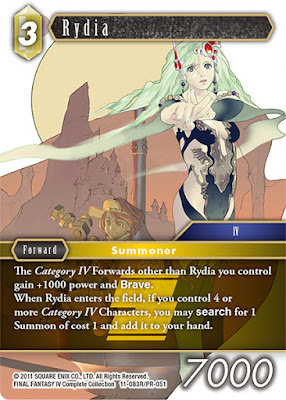
Though she was a promo card at the time, Rydia was still legal to use in the L3 Format for the Opus X meta, and helped ramp up the deck's value to terrifying levels. Buffing all the Category IV Forwards this deck runs with Rydia's effect is great for putting pressure on your opponent, but it also has the added effect of letting you use Golbez as a huge 10K attacker with Brave and then use the Main Phase 2 to dull him for his effect. 


Using Ashe's effect to reactivate a character lets you abuse Golbez's effect twice per turn as long as you have at least 2 active backups to use. Things also become even scarier if you have both her and the aforementioned Rydia on the field. The second effect you choose almost becomes a moot point, but the draw/discard effect can help filter out any Queen of Eblan's you happen to draw into. 


Oh what was that? You wanted another card that gets buffed by Rydia and gives you a stupid amount of value when flipped off the top of the deck? Yeah, this actually happened a few times over several matches, and since there are so many high-cost cards in this deck, it was pretty much guaranteed to break one of your opponent's Forwards. 

This deck was oddly enough kind of the perfect embodiment of what I was trying to do with these challenges - using cards that haven't seen much play to uncover some interesting combos that might have been overlooked in Standard. 

I'm really hoping to see some unexpected stuff for the second challenge considering what cards you guys chose last time...
 

🔰Blooming Onions #2🔰

Featured Cards: Onion Knight (III) 

Format: Standard

Requirements: Deck must run all four colors of Onion Knight (III) with a minimum of 8 total, though you may run more. 


To the surprise of absolutely no one, the winners of the community vote last time were the Onion Knight (III) cards, proving either that you guys love janky cards or are just a bunch of suck ups hoping to curry my favor (it worked, in case you were wondering). In any case despite being the job of everybody's favorite bearded loser, the series of four Onion Knight cards released in Opus X are interesting if not only for the fact that they are some of the most thematically accurate cards to their video game counterparts. 

You see in the Final Fantasy III remake for the Nintendo 3DS, the secret to the Onion Knight class is that compared to the other jobs in the game they're almost totally useless until they reach very high levels, where they experience massive stat growth and finally become nigh invincible. So for those of you who didn't get it, the joke is that I'm an Onion Knight who is still as far off from being good at this game as possible. Har har. 

The cards are a pretty good reflection of this, being incredibly weak Forwards that only become powerful with a massive amount of investment both in the deck they're run in and with how you set up your Backups. While it doesn't say so on the card, there's an errata that actually makes meeting their condition for the power boost quite a bit harder as seen below: 


As if it weren't hard enough to get Backups of four different elements onto the field, if at any point you have two Backups of the same color the Onion Knights won't get boosted. This means that you either have to cap yourself at 4 Backups or run a 5th element, including Light or Dark. So that all seems pretty tough just to get a vanilla Forward with 8k power, so why would you bother running these guys in the first place? 


Pros: 

  • Once their conditions are met, they're incredibly cheap Forwards for that power level, and have no outright negative drawbacks or maintenance costs like other 1CP Fowards such as Leon 6-063H or Zack 11-007R. 
  • Being Job: Standard Units means that they have a ton of cards that can support them. 
  • Their low cost and non special character status means that you can easily flood the board with cheap, powerful forwards. 

Cons: 

  • As stated above, these guys require a ton of setup to be remotely useful so they're next to impossible to slot into any deck that doesn't revolve around them. 
  • All that effort may not really be worth it since they don't really do anything other than being strong attackers/blockers that your opponent probably won't want to trade into. 
  • Their hyper-specific Backup color condition means that they could be susceptible to cards like Hecatoncheir 1-117R or Archer 1-088C, leaving you with a bunch of 2k weenies on the field. 
But as they say, nothing worth having ever came easy. These cards may be worth running just for the sheer satisfaction of seeing the look on your opponent's face if you manage to pull off a win with Onion Knights. So just like last time, the idea behind this deck building challenge isn't if you can make a deck that is viable in the competitive meta, but to see what is the best deck that you can make when you have to use these cards. Here are a few different deck ideas I've come up with that can be a good place to start. 


Build Idea 1: FFIII Warrior of Light

Not only is it thematically cohesive to run the named version of the Onion Knights from Final Fantasy III, they have synergy with Standard Unit builds. Luneth helps make the ability to spam Onion Knights so cheaply a lot more threatening if they enter the field with Haste, and Arc can help make any trades or potential removal even more difficult. 

While the Water Refia from Opus II makes Standard Unit Forwards cost 1 CP less, she also has that pesky caveat that they can't become zero which makes her useless for our purposes here. Instead, the Light Refia from Opus X can make setting up your board much easier, searching and playing any of the other 3 Warriors of Light from the Deck. Refia into Ingus is especially good, since he can play a Standard Unit Backup from your hand to get your Onion Knight's color requirement online quicker.


Build Idea 2: FFI Warrior of Light

Much like the FFIII heroes, there are quite a few different versions of the first Warrior of Light from Final Fantasy I that also deal with Standard Units. The strategy with these tend to have more to do with quickly swarming the field with a lot of smaller Standard Units and getting value off of that like Paladin decks in Hearthstone or whatever the Magic: The Gathering equivalent of that deck style would be. 

The 7CP Warrior of Light from Opus X was initially why I wanted to try a different format outside of Standard for Onion Knight decks, since I figured that might be a little too obvious, but the gamble element and dependence on being on Damage 5 for the (admittedly massive) boost might make him a less consistent choice compared to some of the other options. The Wind Warrior of Light is particularly interesting since you'll actually get free CP whenever you play an Onion Knight, leading to some neat shenanigans. 


Build Idea 3: Moogles 

Getting the Backup element requirement is one of the most challenging things about playing an Onion Knight deck, which means that Moogle decks can help streamline things quite nicely. Starter Deck Serah's ability to search for a Moogle on entry and activate any Moogles after attacking makes this an incredibly effective way to spam the board with Onion Knights and keep the CP flowing. The dulling effect is also a nice way to get pesky Forwards out of the way too. 

The Type-0 Moogle backups are also a great way of getting your Onion Knights boosted since they can generate two specific elements - The Water and Wind ones even cover all the colors of the Onion Knights off of only two backups. You can also run the Category XII Moogle backups with Moogle (FFCC) to give the deck more of an element of control while fulfilling the "rainbow" requirement. 


How to Enter 

So once you've cooked up some of that tasty jank, submit your decklist on ffdecks.com and name your deck "Blooming Onions 2" with whatever your deck name is. For example: Blooming Onions 2 - Electric Boogaloo or something like that. Then post the link to the deck in the comments here! 

So this time around I'm looking into setting up an online tournament using these decks, so if you're interested in duking it out Onion Knight style I'm going to announce it shortly down the line via Facebook once I consult with people who are much smarter than me and who actually know what they're doing. Looking forward to seeing these decks in action! 

Vote For The Next Round!

So that's it for this challenge! I'm looking forward to seeing what everybody comes up with for this one, and discovering who's deck will have the dubious honor of being featured in the next Blooming Onions post. For the next round though I'm doing things a little differently though. Instead of specific cards, I wanted the next one of these to focus on archetypes that were an established "thing" at one point, but never really took off due to lack of support. It would be cool to see how these types of decks fare in modern standard formats since it's been a while since any of them have gotten to see the light of day. You can vote for your choice below until June 30th. If you're having trouble seeing the poll on mobile, click here.


So that's it for this round! Do you guys have any suggestions for cards or archetypes you would like to see in the next one? Let me know what you think! For now, I'll be here trying to figure out how many Onion Knights is too many Onion Knights. 

Until Next Time - Keep on Grinding,